Introduction
My last article looked at terrorist financing and argued that it is often missed because controls built for money laundering are designed around a different pattern of behaviour. Proliferation financing has a similar problem, and in trade finance it may be a sharper one. Since 2022 it has formally been part of the same UK regulatory framework, yet the UK’s own national risk assessment observed that it is often handled as part of money laundering or terrorist financing work instead of as a risk in its own right (HM Treasury, 2021). Within trade finance, it also tends to be treated as a sanctions screening exercise, which is considered complete once every party to a transaction has been checked against the relevant lists.
In my view, that approach answers only part of the question. Proliferation networks have every reason to keep designated names off the documents a bank examines, and the transactions they rely on are often fairly priced and correctly documented. When something does give them away, it is usually the goods themselves, whether those goods make sense for the customer, and the route they take to their final user. The trade finance team sees these details every day. Most proliferation controls, however, are not designed to look at them.
In this article I compare proliferation financing with the trade-based money laundering risks covered in my earlier articles and explain why it is so easily missed in letter of credit business. I then set out what institutions can do to give it more than a screening check.
Regulatory context
In October 2020, the Financial Action Task Force (FATF) revised Recommendation 1 so that countries and the private sector must identify, assess and mitigate proliferation financing risk. The FATF defines that risk narrowly. It means the potential breach, non-implementation or evasion of the targeted financial sanctions under Recommendation 7, which relate to the Democratic People’s Republic of Korea (DPRK) and Iran.
The UK published its first National Risk Assessment of Proliferation Financing in September 2021. It named the DPRK as the primary state actor, followed by Iran. It also found that the UK’s main exposure comes from its role as a provider of financial and corporate services to trade in sensitive items, including goods that are never sourced from the UK, and that private sector awareness of proliferation financing was limited compared with money laundering and terrorist financing (HM Treasury, 2021). The Money Laundering Regulations 2017 were amended from 1 September 2022. Firms must now assess their exposure to proliferation financing under regulation 18A and maintain policies, controls and procedures to manage it under regulation 19A. The definition in regulation 16A covers funds or financial services provided in connection with chemical, biological, radiological or nuclear weapons, their means of delivery and related goods and technology, and it is tied to a breach of a relevant financial sanctions obligation (Money Laundering Regulations 2017, as amended).
In November 2024 the Financial Conduct Authority (FCA) updated its Financial Crime Guide so that it refers to proliferation financing explicitly wherever relevant (FCA, 2024). The FCA’s earlier thematic review of trade finance still matters here. After visiting 17 banks, it found that they generally had effective controls to avoid dealing with sanctioned individuals and entities, but that most had inadequate systems and controls over dual-use goods (FCA, 2013). The UK’s strategic export controls also include end-use, or catch-all, controls. Under these, an exporter may need a licence for an item that is on no control list at all, if there is a risk it is intended for weapons of mass destruction (Export Control Joint Unit, n.d.).
Two more recent developments are relevant. On 28 September 2025, UN sanctions relating to Iran’s nuclear programme were reimposed under the snapback mechanism, and the UK amended its Iran nuclear sanctions regulations with effect from 1 October 2025 to reflect this (Iran (Sanctions) (Nuclear) (EU Exit) (Amendment) Regulations 2025). Earlier this year, HM Treasury also asked regulated firms for evidence to support an update to the national proliferation financing risk assessment (ICAEW, 2026).
How proliferation financing differs from trade-based money laundering
The price is often unremarkable
Most trade-based money laundering controls are built around value. Over-invoicing and under-invoicing are the classic indicators, and pricing that did not fit the goods was the first red flag I discussed in my article on letters of credit. Proliferation financing does not depend on moving value in the same way. As the FATF notes, the funds may come from legitimate activity, including the trade in dual-use goods itself, and may involve no laundering of proceeds at all (FATF, 2021). In my view, a procurement agent buying components for a weapons programme is likely to care more about getting the goods delivered quietly than about the price, and paying the normal market rate helps with that. Pricing anomalies can still appear, and the FATF’s own indicators include prices that differ between invoices and the underlying contracts, and declared values that are low compared with the cost of shipping (FATF, 2021). A control framework that depends on such anomalies, though, will see very little.
The names often screen clear
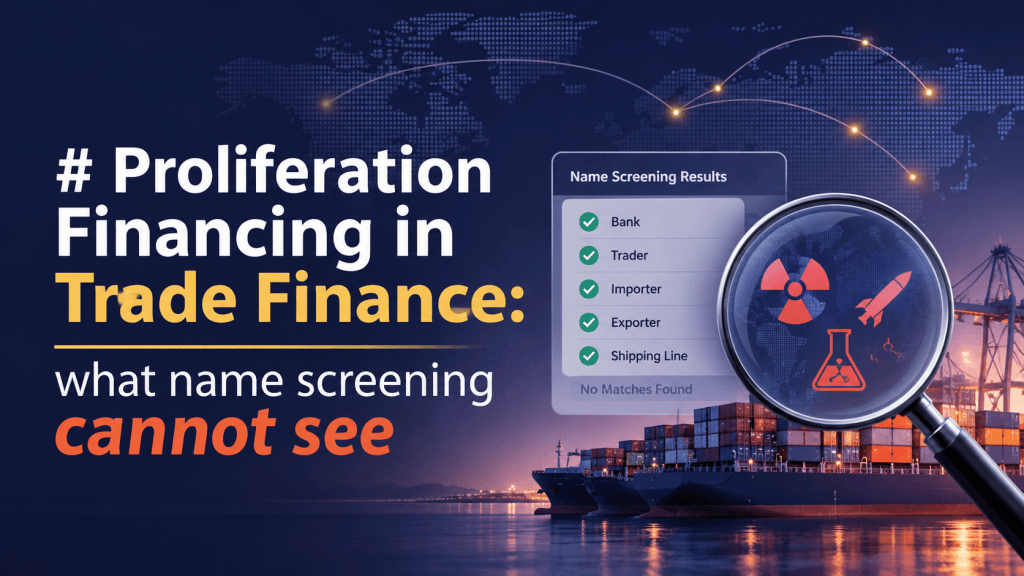
Sanctions screening works well when the designated party appears on the documents. Proliferation networks know this. The FATF observes that designated persons frequently use front and shell companies to hide the fact that funds or goods are reaching them (FATF, 2021). The applicant, the beneficiary, the issuing bank and the shipping company may all screen clear because none of them is designated, and the designated end user may not appear anywhere in the transaction.
The risk sits in the goods description
Dual-use goods have legitimate civilian uses but can also serve military or proliferation purposes. Many of them look unremarkable on paper, such as pumps, valves, sensors, machine tools, certain metals and electronic components. Whether a particular item is controlled can depend on precise technical specifications that never appear on an invoice. The International Chamber of Commerce (ICC), drawing on its own earlier work, reports that screening goods against dual-use lists one transaction at a time has proved ineffective. Its example is the single word “sensor”, which produced 64 matches against UK lists (ICC, 2023). Banks cannot reasonably employ engineers to classify every consignment, as the Wolfsberg Group, ICC and BAFT Trade Finance Principles acknowledge (Wolfsberg Group, ICC and BAFT, 2019). What trade finance staff can do is notice when the goods do not fit the customer, and the FATF lists this among its own indicators (FATF, 2021).
The end user rarely appears on the documents
A letter of credit names an applicant and a beneficiary, and the transport documents name a port of discharge. None of this necessarily tells the bank where the goods will end up or who will use them. Proliferation networks exploit that gap by routing goods through trading companies in transhipment hubs or through countries with weak export controls. The case studies in the UK’s national risk assessment include payments routed through third-party accounts and mis-described invoices used to hide the real end user (HM Treasury, 2021). Among the FATF’s trade finance indicators are inconsistencies in names, addresses or final destination across trade documents and financial flows, and payment instructions from parties who are not named on the original credit (FATF, 2021). A document checker sees all of these details. Usually, though, they are checked only against the terms of the credit, and what they suggest about the destination of the goods goes unexamined.
An illustrative case
Consider a hypothetical UK bank that is asked to confirm an export letter of credit for one of its corporate customers, a small distributor of industrial components. The customer has banked with the institution for several years and mainly supplies heating and ventilation parts to building contractors in the UK and in Europe.
The credit is issued by a bank in a third country on behalf of a trading company incorporated eighteen months earlier in a regional transhipment hub. It covers a consignment of high-precision pressure transducers, corrosion-resistant valves and associated spare parts. The invoice values match published list prices, and the credit allows both partial shipments and transhipment. The documents arrive on time and comply with the terms of the credit. Every party screens clear against the UK, UN, EU and US sanctions lists, and nothing in the payment instructions raises a concern.
From the bank’s point of view, this is a clean transaction. The pricing is normal, the presentation complies and screening has produced no matches. Nobody is prompted to ask why a heating and ventilation distributor is suddenly exporting precision instruments, or whether the goods need an export licence. Nor does anyone ask what a newly established trading company in a transhipment hub intends to do with them. Some types of pressure transducers and valves appear on international dual-use control lists because of their applications in nuclear programmes. The bank does not need to know which control entry might apply to see that an unfamiliar product line, a new and distant buyer and a route that allows transhipment together justify a question.
None of these features proves anything on its own, and the customer may have a perfectly good explanation, such as a new contract or a licence already obtained. The problem is that the bank’s controls were never designed to ask for one. The transaction was reviewed for documentary compliance and for sanctioned names, and it passed on both counts.
Why proliferation financing is often missed in trade finance
The first reason is that proliferation financing is often treated as a subset of sanctions compliance. Because the regulatory definition is tied to financial sanctions, many institutions conclude that screening is the control and that a clear screening result settles the matter. From what I have observed, firm-wide proliferation financing risk assessments prepared since 2022 frequently restate the sanctions screening framework and say little about goods, end use or trade routes, even though that is where the risk in trade finance actually lies.
The second reason is the division of responsibility between banks and exporters. Export licensing is the exporter’s legal obligation, and the ICC rightly points out that exporters, customs authorities and licensing agencies are better placed than banks to identify controlled goods (ICC, 2023). That division is reasonable, but it is often read as meaning the bank has no part to play at all. A bank that never asks whether a licence was required, even when the goods and the destination clearly call for the question, is relying on its customer’s compliance with no basis for doing so.
The third reason is the way trade operations teams are trained and measured. As I discussed in my article on letters of credit, document checkers are trained to compare documents with the terms of the credit and are assessed on accuracy and turnaround, so what the goods can be used for is rarely part of the review. From my time in trade finance, I would say that a checker who paused a complying presentation to ask about the end use of a valve would have needed a clear procedure and a supportive manager to do so.
Finally, proliferation financing cases are rare in any single institution, and the national risk assessment found that private sector awareness of the risk was limited (HM Treasury, 2021). With so few cases to learn from, staff have little chance to build experience, and it is harder to justify spending on controls for a risk that seldom produces an alert. The national risk assessment that HM Treasury is now preparing gives institutions a good opportunity to revisit that judgment.
Practical measures
Institutions do not need specialist engineers to strengthen their proliferation financing controls in trade finance. They do need those controls to look past names. In practical terms, they should consider the following measures:
- Assess proliferation financing risk on its own terms. The regulation 18A risk assessment should consider exposure by product, customer type, trade corridor and goods sector, drawing on the national risk assessment and FATF indicators, and should do more than restate the sanctions screening framework.
- Know which customers trade in sensitive goods. Customers that manufacture or distribute items with potential dual-use applications should be identified at onboarding and at periodic review, with their expected products, markets and export licensing arrangements recorded.
- Ask about export licences when the combination of goods and destination calls for it. For higher-risk transactions, asking for a licence reference or the customer’s own classification statement is a proportionate step, and it leaves the answer with the party that has the technical knowledge.
- Check whether the goods fit the customer. Checklists for trade operations staff should prompt them to consider whether the goods match the customer’s business and whether the buyer is new, recently incorporated or based in a transhipment hub. They should also ask whether the route lets the goods change direction without an obvious commercial reason.
- Use targeted screening in place of broad goods lists. Running every goods description against long dual-use lists produces large volumes of false positives. Screening against higher-risk entity lists, and focusing enhanced due diligence on customers and corridors with genuine exposure, is likely to work better (ICC, 2023).
- Train trade finance staff with proliferation cases specifically. When training presents proliferation financing only as part of sanctions compliance, it reinforces the idea that screening is enough. Case-based training helps staff recognise the patterns that matter.
Conclusion
Sanctions screening is an essential control, and the FCA’s 2013 review found that banks generally did it well. The difficulty is that proliferation networks are often organised so that screening will find nothing. Their transactions tend to be fairly priced and correctly documented, and the parties involved have clean names. A framework that looks for mispricing and designated names will therefore report a clear result while the real indicators pass through unexamined.
Those indicators are not hidden from the bank. They sit in the goods description, in the customer’s usual line of business, in the age and location of the buyer and in the shipping terms of the credit, and all of them cross the trade finance desk as a matter of routine. Making proliferation financing controls effective in trade finance therefore depends less on new technology and more on the people who examine these documents. They need a reason to ask what the goods are for, along with the guidance and the authority to do it.
References
Export Control Joint Unit (n.d.) End-use controls applying to WMD-related items, including technical help. London: Department for Business and Trade. Available at: GOV.UK.
Financial Action Task Force (FATF) (2021) Guidance on Proliferation Financing Risk Assessment and Mitigation. June. Paris: FATF.
Financial Conduct Authority (FCA) (2013) Banks’ Control of Financial Crime Risks in Trade Finance (TR13/3). July. London: FCA.
Financial Conduct Authority (FCA) (2024) Financial Crime Guide: A Firm’s Guide to Countering Financial Crime Risks. Updated 29 November. London: FCA.
HM Treasury (2021) National Risk Assessment of Proliferation Financing. September. London: HM Treasury.
ICAEW (2026) Respond to HM Treasury’s survey on proliferation financing. February. London: ICAEW.
International Chamber of Commerce (ICC) (2023) Financial Crime Risk Controls: Dual-Use Goods and Proliferation Financing. June. Paris: ICC.
The Iran (Sanctions) (Nuclear) (EU Exit) (Amendment) Regulations 2025 (SI 2025/1052). London: The Stationery Office.
The Money Laundering, Terrorist Financing and Transfer of Funds (Information on the Payer) Regulations 2017 (SI 2017/692), as amended by The Money Laundering and Terrorist Financing (Amendment) (No. 2) Regulations 2022 (SI 2022/860). London: The Stationery Office.
Wolfsberg Group, International Chamber of Commerce and BAFT (2019) Trade Finance Principles. 2019 amendment. Wolfsberg Group.


Leave a Reply