Introduction
In my earlier article on Trade-Based Money Laundering (TBML), I examined how this form of laundering operates and why it remains one of the most difficult financial crime risks to detect. That article approached the subject from a broad, framework-level perspective. This article takes a narrower and more practical view, looking at TBML from the position of the person who examines the documents.
Before moving into risk and compliance in the UK, I spent several years working in international trade finance, handling import and export letters of credit. On a daily basis, invoices, bills of lading, packing lists and certificates of origin were presented for examination, and the role was to check each set against the terms of the credit and determine whether the presentation complied.
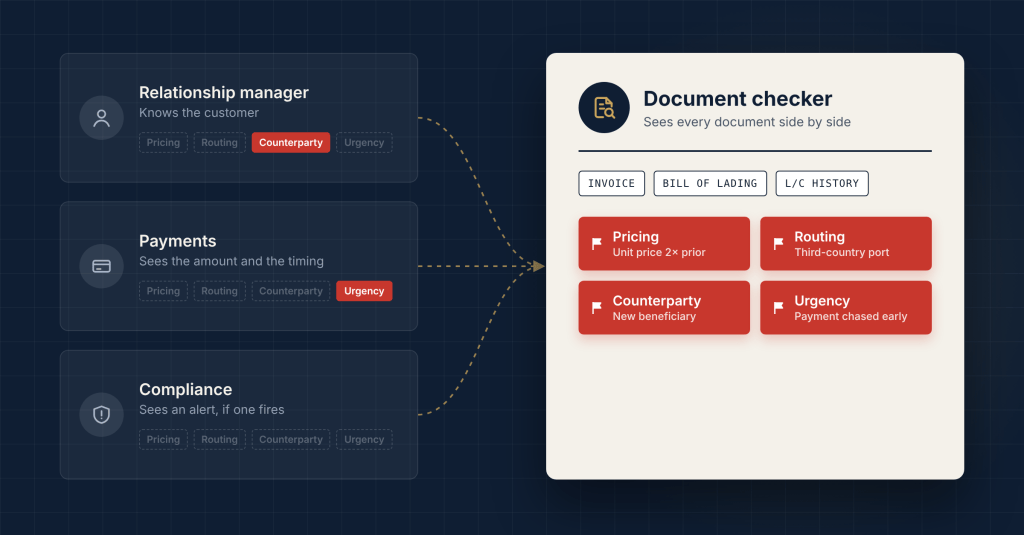
What I did not fully appreciate at the time, but recognise clearly now, is that the document checker is often the only person in the entire transaction who sees every document side by side. This makes the examination desk one of the most valuable points in the bank for identifying TBML, and, at the same time, one of the places where it is most easily overlooked.
What the document checker is trained to look for
Letters of credit are governed by the International Chamber of Commerce’s Uniform Customs and Practice for Documentary Credits (UCP 600). Article 5 establishes the underlying principle that banks deal with documents and not with the goods to which those documents relate. Article 14 requires the examining bank to determine, on the basis of the documents alone, whether they appear on their face to constitute a complying presentation. Article 34 goes further, stating that a bank assumes no liability for the accuracy, genuineness or falsification of any document (ICC, 2007).
As a result, document checkers are trained to identify discrepancies, such as a shipment date outside the permitted period, a beneficiary name spelt differently across documents, a missing signature or a port of loading that does not match the credit. These are the issues that lead to a presentation being rejected or returned with a notice of refusal, and they form the core of a checker’s professional expertise.
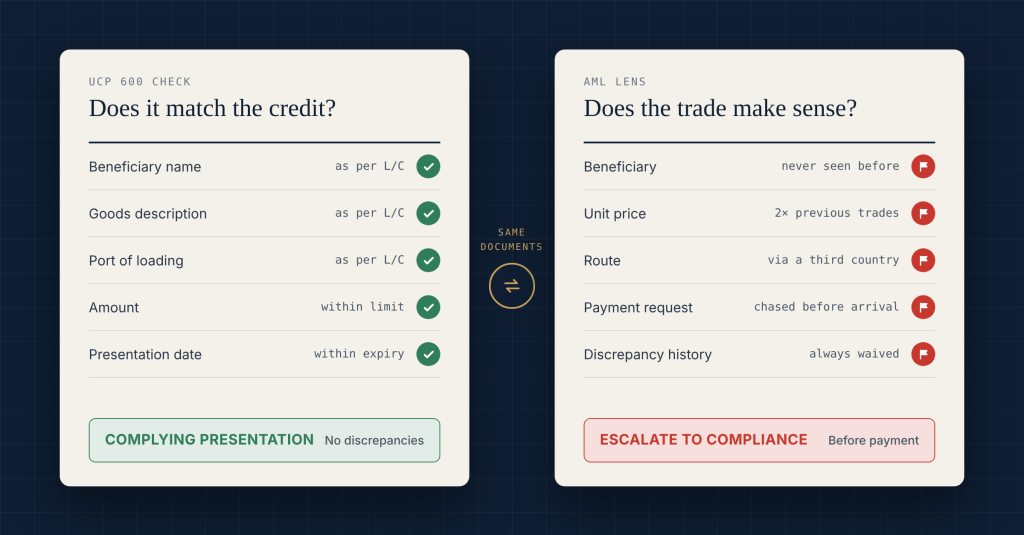
This training is valuable, but it was designed for a different purpose. Documentary compliance asks whether the documents match the terms of the credit, whereas anti-money laundering asks whether the underlying trade makes commercial sense. A presentation can be entirely compliant under UCP 600 and still describe a trade that never took place, or one priced at several times its genuine market value.
The Trade Finance Principles published by the Wolfsberg Group, the ICC and BAFT recognise this distinction. Banks are not expected to verify every shipment physically, but they are expected to identify and escalate unusual features that are apparent from the information available to them (Wolfsberg Group, ICC and BAFT, 2019). The practical question, therefore, is whether document checkers have been given the mandate, the time and the training to look for those features.
Red flags within letter of credit documents
The Financial Action Task Force (FATF) and the Egmont Group have published a detailed set of TBML risk indicators (FATF and Egmont Group, 2020). Many such lists, however, are written primarily for investigators and financial intelligence units. The indicators below are those which, in my experience, are most likely to appear within a set of letter of credit documents.
Pricing that is inconsistent with the goods
Unit prices that are significantly above or below expected market levels remain the most recognised indicator of over-invoicing or under-invoicing. Although document checkers rarely have access to pricing databases, experienced staff often have a reasonable sense of what a consignment of rice, garments or machinery parts should cost, having examined many similar transactions. Where a unit price appears unusual, it warrants further consideration, even when the arithmetic on the invoice is correct.
Vague or generic descriptions of goods
Descriptions such as “general merchandise”, “spare parts” or “assorted goods” on an invoice of significant value should prompt further enquiry. UCP 600 permits documents other than the commercial invoice to describe the goods in general terms, but the description on the commercial invoice must correspond with that in the credit. Where the credit itself has been drafted with a vague description, this should be recognised as a deliberate choice rather than an administrative oversight.
Shipping arrangements that lack commercial rationale
Indicators in this area include goods routed through a third country without an apparent business reason, transport documents naming a vessel that would not ordinarily call at the stated port, shipment quantities that are inconsistent with the container type, and credits permitting transhipment where the route does not require it. Each of these may have a legitimate explanation, but when several appear together, they present a pattern that should not be dismissed.
Parties that do not fit the trade
Concerns may arise where the beneficiary’s business has no apparent connection to the goods being traded, where payment is requested to a third party in a different jurisdiction, where the applicant and beneficiary appear to be related or share an address, or where a recently incorporated company begins opening credits of substantial value. Because document checkers see the same counterparties repeatedly across presentations, they are well placed to notice when these relationships change or appear inconsistent.
Frequent or unusual amendments
Repeated amendments that increase the credit amount, extend the expiry date or change the beneficiary may indicate that the transaction is being shaped around something other than the underlying goods. Similarly, a credit that is cancelled and reissued with only minor changes should be examined carefully to understand the reason for the change.
Discrepancies that are consistently waived
In my view, this is one of the most significant indicators. Where an applicant routinely accepts every discrepancy without question, including material ones, it may suggest that the applicant has little genuine interest in whether the documents are accurate. A legitimate buyer, by contrast, generally has a strong commercial interest in ensuring that the documents correctly reflect the goods being purchased.
An illustrative presentation
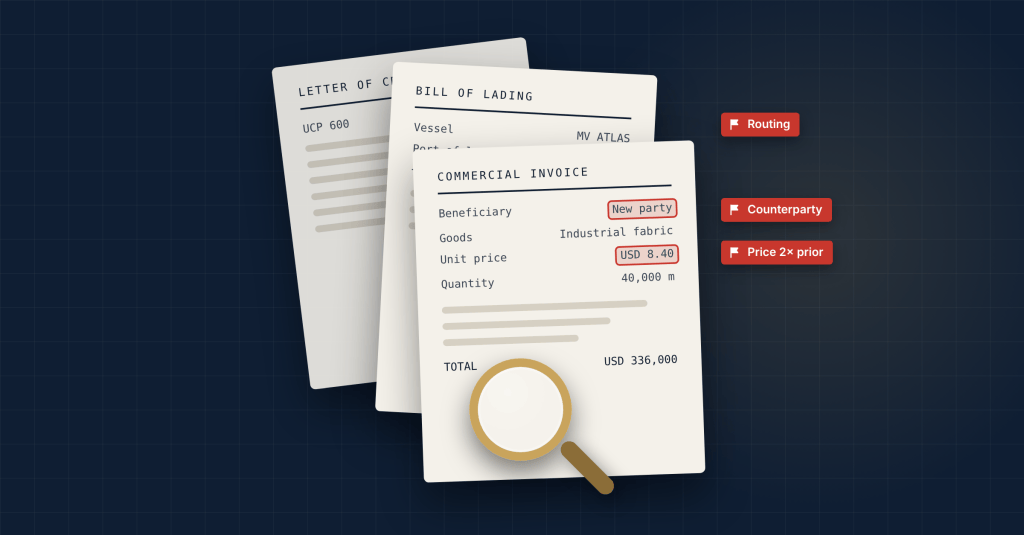
Consider an import letter of credit for industrial fabric, issued on behalf of a long-standing customer. The documents are presented within the validity period, and the invoice, bill of lading, packing list and certificate of origin all comply with the terms of the credit. On examination, no discrepancies are identified.
However, several details do not sit comfortably together. The unit price is approximately double the price the same applicant paid for similar fabric six months earlier. The goods were shipped from a port in a third country rather than from the supplier’s home country. The beneficiary is a company the bank has not previously dealt with, even though the goods are the same as in earlier transactions. In addition, the applicant requested, before the documents had even arrived, that payment be processed as quickly as possible.
From a UCP 600 perspective, this is a complying presentation, and the bank would ordinarily be obliged to honour it. From an anti-money laundering perspective, however, it contains four separate indicators: pricing, routing, a change of counterparty and urgency. None of these individually proves wrongdoing, but taken together they provide sufficient grounds to consult the compliance function before payment is released.
What this example illustrates is that the document checker is often the only person positioned to see all four indicators at once. The relationship manager understands the customer, the payments team sees the amount, and the compliance team sees an alert if one is generated. Only the document checker has the invoice, the transport document and the history of the credit available at the same time.
Why these indicators are often missed
From what I have observed, the issue is rarely that document checkers are unable to recognise these signs. More often, the role is simply not structured in a way that allows them to act on what they see.
Time pressure is a significant factor. UCP 600 allows a maximum of five banking days following presentation to examine the documents, and internal service standards are frequently tighter, particularly where customers are pressing for payment. Under these conditions, checkers naturally concentrate on identifying discrepancies, because that is the measure against which their work is assessed.
Professional mindset also plays a part. Years of training in documentary examination build a habit of asking whether the documents match, rather than whether the transaction makes sense. These are fundamentally different questions, and the second is rarely reflected in trade operations procedures.
Finally, there is often a structural separation between trade operations and the financial crime function. Document checkers usually sit within operations, while financial crime oversight sits within the second line of defence. Where there is no straightforward route for a checker to raise a concern, and no feedback when a concern is raised, escalations gradually decline. I discussed this in my earlier articles on the execution gap in AML, and trade finance provides one of the clearest examples of it.
Strengthening the role of the document checker
Addressing this issue does not require significant investment in new systems. It largely depends on giving document checkers a clearly defined role in financial crime control and supporting them when they exercise it. In practical terms, institutions should consider the following measures:
- Incorporate TBML prompts into the examination checklist. A small number of targeted questions, such as whether the pricing appears reasonable, whether the shipping route is commercially logical and whether the parties are consistent with the nature of the trade, can shift the checker’s focus from documentary compliance alone to the substance of the transaction.
- Establish a clear and simple escalation route. A named contact within compliance and a short escalation form are usually sufficient, provided that raising a concern does not penalise the checker against turnaround targets.
- Provide feedback on escalations. Where a checker raises a concern, they should be informed of the outcome. Without this feedback, staff have little incentive to continue escalating, and the quality of referrals declines over time.
- Monitor waived discrepancies at customer level. Customers who consistently waive discrepancies should be subject to periodic review. This information is already held in most trade finance systems but is rarely analysed from a financial crime perspective.
- Use real cases in training. FATF and Egmont typologies provide a useful foundation, but anonymised internal cases are considerably more effective, because staff relate them directly to the transactions they handle.
- Build trade finance expertise within compliance. Compliance teams reviewing trade-related alerts need staff who understand letters of credit, Incoterms and shipping documentation. Without this knowledge, the second line is unable to provide meaningful challenge to the first.
The Financial Conduct Authority’s Financial Crime Guide expects firms to apply a risk-based approach to trade finance and to understand the purpose of the transactions they facilitate (FCA, 2023). Within trade finance, that understanding begins at the document checker’s desk.
Conclusion
TBML is frequently discussed in terms of global trade data, cooperation between customs authorities and advanced analytics. These elements are important, but within a bank, the first and often the only opportunity to identify a suspicious trade arises when the documents are examined.
UCP 600 requires the document checker to assess the documents on their face, but it does not prevent the checker from recognising when something about those documents appears wrong. Institutions that treat their trade operations teams as an integral part of their financial crime defences, and provide them with the time, guidance and escalation routes needed to act, will be better positioned to detect activity that automated monitoring alone is unlikely to identify.
Having learned documentary examination long before I developed an interest in financial crime, I have come to recognise that these two disciplines were never as separate as organisational structures tend to suggest. Bringing them closer together may be one of the most practical steps institutions can take in addressing TBML risk.
References
Financial Action Task Force (FATF) (2006) Trade Based Money Laundering. Paris: FATF.
Financial Action Task Force (FATF) and Egmont Group (2020) Trade-Based Money Laundering: Risk Indicators. Paris: FATF.
Financial Conduct Authority (FCA) (2023) Financial Crime Guide: A Firm’s Guide to Countering Financial Crime Risks. London: FCA.
International Chamber of Commerce (ICC) (2007) Uniform Customs and Practice for Documentary Credits, UCP 600. Paris: ICC.
Wolfsberg Group, International Chamber of Commerce and BAFT (2019) Trade Finance Principles. Wolfsberg Group.
This article is also available on LinkedIn for wider readership.


Leave a comment