Introduction
Global trade plays a central role in the modern financial system by facilitating the movement of goods, services, and capital across international markets. The expansion of international trade has contributed significantly to economic development, financial integration, and globalisation. However, alongside these benefits, global trade has also created opportunities for financial crime. One of the most significant risks emerging from this environment is Trade-Based Money Laundering (TBML).
Trade-Based Money Laundering is widely recognised as one of the most complex forms of money laundering due to its ability to operate through legitimate commercial activity. Unlike conventional laundering methods that primarily focus on the movement of cash, TBML focuses on the transfer of value through manipulation of trade transactions. This makes detection particularly difficult, as transactions often appear commercially genuine on the surface.
The Financial Action Task Force (FATF) identifies TBML as a major global vulnerability within the anti-money laundering framework, particularly because of the volume and complexity of international trade activity (FATF, 2006). Despite increasing regulatory attention, financial institutions and regulatory authorities continue to face significant challenges in identifying and mitigating TBML risks effectively.
This article examines the concept of Trade-Based Money Laundering, its mechanisms, key vulnerabilities within trade finance operations, and the challenges faced by financial institutions in managing this risk.
Understanding Trade-Based Money Laundering
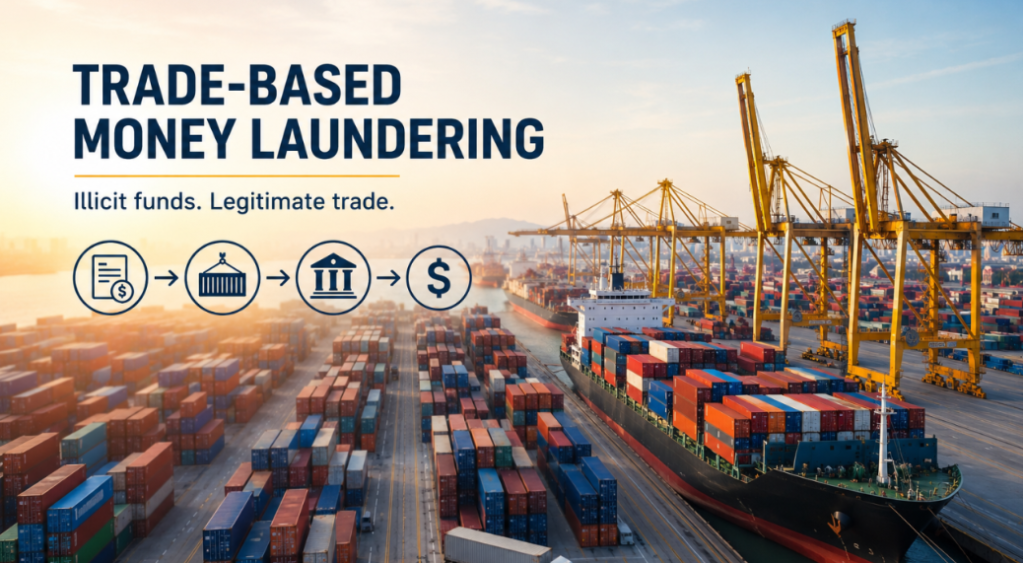
Trade-Based Money Laundering refers to the process of disguising the proceeds of crime and transferring value through trade transactions in order to legitimise illicit funds. According to the Financial Action Task Force:
“Trade-Based Money Laundering is the process of disguising the proceeds of crime and moving value through the use of trade transactions in an attempt to legitimise their illicit origins” (FATF, 2006).
The key characteristic of TBML is that it exploits the international trade system rather than relying solely on traditional banking channels. Criminal organisations manipulate invoices, pricing structures, quantities, and shipping documentation to transfer value across borders while concealing the origin of illicit funds.
TBML is particularly attractive to criminal networks because international trade transactions naturally involve large payment volumes, multiple jurisdictions, numerous intermediaries, and extensive documentation. These characteristics create an environment where illicit transactions can blend into legitimate commercial activity with limited visibility.
Common techniques used in TBML
Several techniques are commonly used within Trade-Based Money Laundering schemes. Although the methods may differ depending on the nature of the trade activity, the underlying objective remains the same: the movement of illicit value under the appearance of legitimate trade.
Over-Invoicing : Over-invoicing occurs when the value of goods or services is deliberately inflated on commercial documentation. In this scenario, the importer transfers funds exceeding the actual value of the goods, enabling excess value to be moved internationally under the guise of legitimate trade payments.
Under-Invoicing : Under-invoicing involves declaring goods at a value lower than their actual market price. This technique allows value to be transferred in the opposite direction while potentially reducing tax and customs obligations.
Multiple Invoicing : Multiple invoicing occurs when the same shipment is supported by several invoices, allowing repeated payments for a single trade transaction. This technique can be difficult to identify where institutions lack visibility across interconnected transactions.
Phantom Shipments : Phantom shipments involve completely fictitious trade transactions where no physical goods are transported. Fraudulent shipping and trade documents are created to justify payments between parties.
Misrepresentation of Goods : This method involves deliberately falsifying the quality, quantity, or description of goods within trade documentation. The declared goods may not reflect the actual shipment, enabling value manipulation.
These techniques demonstrate that TBML does not necessarily rely on sophisticated financial engineering. Instead, it exploits weaknesses in trade verification processes and operational controls.
The relationship between trade finance and TBML
Trade finance products play a critical role in facilitating international commerce. Instruments such as Letters of Credit, Documentary Collections, and Open Account transactions help reduce counterparty risk and support payment assurance between importers and exporters. However, these same products can also create vulnerabilities when controls are ineffective.
Trade finance transactions often involve multiple parties, including importers, exporters, banks, shipping companies, customs authorities, and insurers. Each participant has access to only part of the transaction process. As a result, no single institution possesses complete visibility over the entire trade flow. This fragmented structure creates significant opportunities for exploitation.
Financial institutions primarily rely on documentation when processing trade transactions. Banks generally do not physically inspect goods and therefore depend heavily on commercial invoices, transport documents, and declarations submitted by customers. Where documentation appears consistent, transactions may proceed despite underlying manipulation.
The Financial Conduct Authority (FCA) has emphasised that firms must apply a risk-based approach to financial crime controls and understand the purpose and nature of customer transactions (FCA, 2023). However, in practice, operational pressures and transaction volumes often limit the depth of scrutiny applied.
Challenges in detecting TBML
The detection of Trade-Based Money Laundering remains a major challenge for financial institutions and regulatory authorities. Several structural and operational issues contribute to this difficulty.
High Transaction Volumes International trade generates enormous transaction volumes on a daily basis. The scale of activity makes it difficult for institutions to conduct detailed analysis on every transaction.
Limited Visibility : Banks typically see financial and documentary aspects of a transaction, while customs authorities observe physical goods movement. Shipping companies and logistics providers hold additional information. The absence of integrated visibility significantly weakens detection capabilities.
Data Quality and Fragmentation : Trade-related information is often spread across multiple systems with inconsistent formatting and varying data quality. Weak data governance reduces the effectiveness of transaction monitoring systems and investigative processes.
Commercial Complexity : Certain industries naturally involve fluctuating pricing structures, making it difficult to identify abnormal valuations. Market volatility can further complicate pricing assessments.
Operational Focus on Process Rather Than Risk : In many institutions, trade finance controls become procedural exercises focused on document completion rather than genuine risk assessment. Transactions may satisfy operational requirements while underlying financial crime risks remain unidentified.
These challenges illustrate why TBML continues to remain a significant vulnerability within the global financial system.
Strengthening controls against TBML
Addressing TBML requires a combination of regulatory compliance, operational effectiveness, and enhanced analytical capability. Financial institutions should strengthen collaboration between trade finance operations, compliance functions, and financial crime investigation teams. Effective communication between these functions is essential to identify unusual trade patterns and inconsistencies.
Improved data governance is also critical. Institutions must ensure that trade-related information is accurate, standardised, and accessible for monitoring purposes. Weak data quality directly undermines control effectiveness.
In addition, firms should adopt enhanced pricing verification processes. Benchmarking invoice values against market data can help identify suspicious pricing discrepancies that may indicate TBML activity.
Technology and data analytics are increasingly important in this area. Advanced monitoring tools capable of identifying behavioural anomalies and transaction patterns may improve detection capabilities. The Bank for International Settlements (BIS) has highlighted the growing importance of data analytics and technological innovation in strengthening financial crime controls within the banking sector (BIS, 2021).
However, technology alone is insufficient. Institutions must also invest in expertise. Effective TBML risk management requires personnel with strong knowledge of trade finance operations, international trade documentation, and financial crime typologies.
Conclusion
Trade-Based Money Laundering represents one of the most significant and complex risks within the global financial system. By exploiting legitimate trade activity, TBML enables criminal organisations to transfer illicit value across jurisdictions while avoiding detection through traditional anti-money laundering controls.
The complexity of international trade, fragmented oversight structures, and heavy reliance on documentation create substantial vulnerabilities for financial institutions. Although regulatory expectations continue to evolve, operational challenges remain significant.
Addressing TBML effectively requires more than regulatory compliance. Institutions must move beyond process-driven controls and adopt risk-focused approaches supported by strong data governance, integrated operational functions, and specialised expertise.
As international trade continues to expand and financial crime methodologies evolve, the ability of institutions to identify and manage TBML risk will remain a critical component of global financial system integrity.
References
Bank for International Settlements (2021). Sound Practices: Implications of FinTech Developments for Banks and Bank Supervisors. Basel: BIS.
Financial Action Task Force (2006). Trade Based Money Laundering. Paris: FATF.
Financial Action Task Force (2020). Risk-Based Approach Guidance for the Banking Sector. Paris: FATF.
Financial Conduct Authority (2023). Financial Crime Guide. London: FCA.
This article is also available on LinkedIn for wider readership.


Leave a comment